Tajweed Curriculum: Pre-K to Grade 8
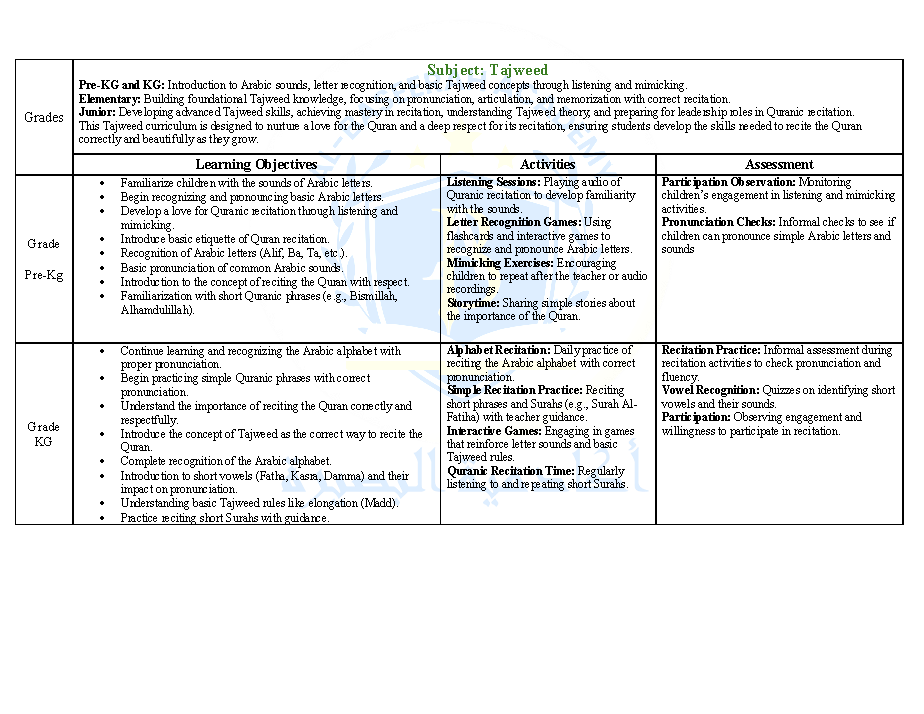
This Tajweed curriculum is designed to nurture a love for the Quran and a deep respect for its recitation, ensuring students develop the skills needed to recite the Quran correctly and beautifully as they grow.
It runs in three broad stages. Pre-K and Kindergarten introduce Arabic sounds, letter recognition and basic Tajweed concepts through listening and mimicking. Elementary builds foundational Tajweed knowledge, focusing on pronunciation, articulation and memorization with correct recitation. Junior develops advanced Tajweed skills, achieving mastery in recitation, understanding Tajweed theory and preparing for leadership roles in Quranic recitation.
Pre-K
Learning objectives
- Familiarize children with the sounds of Arabic letters.
- Begin recognizing and pronouncing basic Arabic letters.
- Develop a love for Quranic recitation through listening and mimicking.
- Introduce basic etiquette of Quran recitation.
- Recognition of Arabic letters (Alif, Ba, Ta and so on).
- Basic pronunciation of common Arabic sounds.
- Introduction to the concept of reciting the Quran with respect.
- Familiarization with short Quranic phrases such as Bismillah and Alhamdulillah.
Activities
- Listening sessions: playing audio of Quranic recitation to develop familiarity with the sounds.
- Letter recognition games: flashcards and interactive games to recognize and pronounce Arabic letters.
- Mimicking exercises: encouraging children to repeat after the teacher or audio recordings.
- Storytime: simple stories about the importance of the Quran.
Assessment
- Participation observation: monitoring engagement in listening and mimicking activities.
- Pronunciation checks: informal checks to see if children can pronounce simple Arabic letters and sounds.
Kindergarten
Learning objectives
- Continue learning and recognizing the Arabic alphabet with proper pronunciation.
- Begin practicing simple Quranic phrases with correct pronunciation.
- Understand the importance of reciting the Quran correctly and respectfully.
- Introduce the concept of Tajweed as the correct way to recite the Quran.
- Complete recognition of the Arabic alphabet.
- Introduction to short vowels (Fatha, Kasra, Damma) and their impact on pronunciation.
- Understanding basic Tajweed rules such as elongation (Madd).
- Practice reciting short Surahs with guidance.
Activities
- Alphabet recitation: daily practice of reciting the Arabic alphabet with correct pronunciation.
- Simple recitation practice: reciting short phrases and Surahs, such as Surah Al-Fatiha, with teacher guidance.
- Interactive games: games that reinforce letter sounds and basic Tajweed rules.
- Quranic recitation time: regularly listening to and repeating short Surahs.
Assessment
- Recitation practice: informal assessment during recitation activities to check pronunciation and fluency.
- Vowel recognition: quizzes on identifying short vowels and their sounds.
- Participation: observing engagement and willingness to participate in recitation.
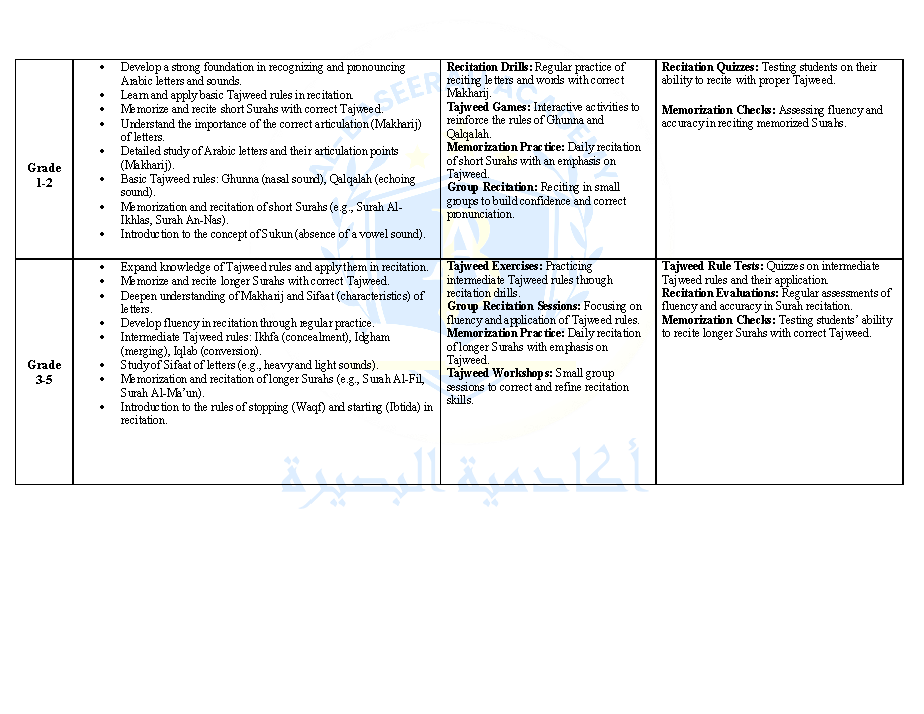
Grades 1 and 2
Learning objectives
- Develop a strong foundation in recognizing and pronouncing Arabic letters and sounds.
- Learn and apply basic Tajweed rules in recitation.
- Memorize and recite short Surahs with correct Tajweed.
- Understand the importance of correct articulation (Makharij) of letters.
- Detailed study of Arabic letters and their articulation points (Makharij).
- Basic Tajweed rules: Ghunna (nasal sound), Qalqalah (echoing sound).
- Memorization and recitation of short Surahs such as Surah Al-Ikhlas and Surah An-Nas.
- Introduction to the concept of Sukun (absence of a vowel sound).
Activities
- Recitation drills: regular practice reciting letters and words with correct Makharij.
- Tajweed games: interactive activities to reinforce the rules of Ghunna and Qalqalah.
- Memorization practice: daily recitation of short Surahs with an emphasis on Tajweed.
- Group recitation: reciting in small groups to build confidence and correct pronunciation.
Assessment
- Recitation quizzes: testing students on their ability to recite with proper Tajweed.
- Memorization checks: assessing fluency and accuracy in reciting memorized Surahs.
Grades 3 to 5
Learning objectives
- Expand knowledge of Tajweed rules and apply them in recitation.
- Memorize and recite longer Surahs with correct Tajweed.
- Deepen understanding of Makharij and Sifaat (characteristics) of letters.
- Develop fluency in recitation through regular practice.
- Intermediate Tajweed rules: Ikhfa (concealment), Idgham (merging), Iqlab (conversion).
- Study of Sifaat of letters, such as heavy and light sounds.
- Memorization and recitation of longer Surahs such as Surah Al-Fil and Surah Al-Ma’un.
- Introduction to the rules of stopping (Waqf) and starting (Ibtida) in recitation.
Activities
- Tajweed exercises: practicing intermediate Tajweed rules through recitation drills.
- Group recitation sessions: focusing on fluency and application of Tajweed rules.
- Memorization practice: daily recitation of longer Surahs with emphasis on Tajweed.
- Tajweed workshops: small group sessions to correct and refine recitation skills.
Assessment
- Tajweed rule tests: quizzes on intermediate Tajweed rules and their application.
- Recitation evaluations: regular assessments of fluency and accuracy in Surah recitation.
- Memorization checks: testing students’ ability to recite longer Surahs with correct Tajweed.
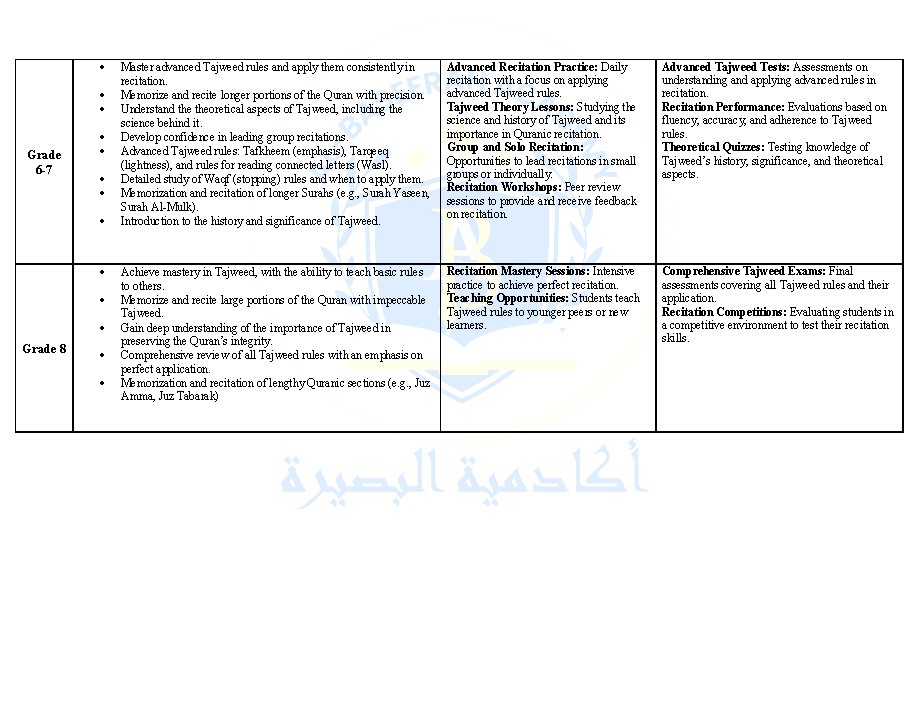
Grades 6 and 7
Learning objectives
- Master advanced Tajweed rules and apply them consistently in recitation.
- Memorize and recite longer portions of the Quran with precision.
- Understand the theoretical aspects of Tajweed, including the science behind it.
- Develop confidence in leading group recitations.
- Advanced Tajweed rules: Tafkheem (emphasis), Tarqeeq (lightness), and rules for reading connected letters (Wasl).
- Detailed study of Waqf (stopping) rules and when to apply them.
- Memorization and recitation of longer Surahs such as Surah Yaseen and Surah Al-Mulk.
- Introduction to the history and significance of Tajweed.
Activities
- Advanced recitation practice: daily recitation focusing on applying advanced Tajweed rules.
- Tajweed theory lessons: studying the science and history of Tajweed and its importance in Quranic recitation.
- Group and solo recitation: opportunities to lead recitations in small groups or individually.
- Recitation workshops: peer review sessions to provide and receive feedback on recitation.
Assessment
- Advanced Tajweed tests: assessments on understanding and applying advanced rules in recitation.
- Recitation performance: evaluations based on fluency, accuracy and adherence to Tajweed rules.
- Theoretical quizzes: testing knowledge of Tajweed’s history, significance and theoretical aspects.
Grade 8
Learning objectives
- Achieve mastery in Tajweed, with the ability to teach basic rules to others.
- Memorize and recite large portions of the Quran with impeccable Tajweed.
- Gain deep understanding of the importance of Tajweed in preserving the Quran’s integrity.
- Comprehensive review of all Tajweed rules with an emphasis on perfect application.
- Memorization and recitation of lengthy Quranic sections such as Juz Amma and Juz Tabarak.
Activities
- Recitation mastery sessions: intensive practice to achieve perfect recitation.
- Teaching opportunities: students teach Tajweed rules to younger peers or new learners.
Assessment
- Comprehensive Tajweed exams: final assessments covering all Tajweed rules and their application.
- Recitation competitions: evaluating students in a competitive environment to test their recitation skills.
Curriculum outline
The same outline as published tables: