Quran Curriculum: Pre-K to Grade 8
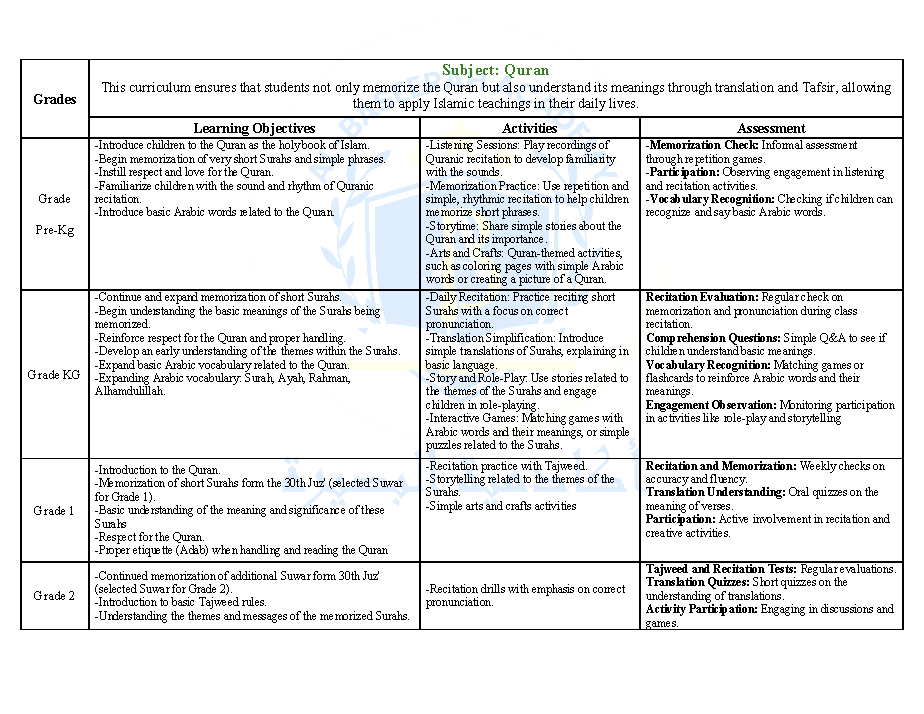
This curriculum ensures that students not only memorize the Quran but also understand its meanings through translation and Tafsir, allowing them to apply Islamic teachings in their daily lives.
Below is the grade-by-grade outline taught at Al Baseerah Academy, setting out the learning objectives, classroom activities and assessment methods at each stage.
Pre-K
Learning objectives
- Introduce children to the Quran as the holy book of Islam.
- Begin memorization of very short Surahs and simple phrases.
- Instill respect and love for the Quran.
- Familiarize children with the sound and rhythm of Quranic recitation.
- Introduce basic Arabic words related to the Quran.
Activities
- Listening sessions: recordings of Quranic recitation, to develop familiarity with the sounds.
- Memorization practice: repetition and simple, rhythmic recitation to help children memorize short phrases.
- Storytime: simple stories about the Quran and its importance.
- Arts and crafts: Quran-themed activities, such as coloring pages with simple Arabic words.
Assessment
- Memorization check: informal assessment through repetition games.
- Participation: observing engagement in listening and recitation activities.
- Vocabulary recognition: checking if children can recognize and say basic Arabic words.
Kindergarten
Learning objectives
- Continue and expand memorization of short Surahs.
- Begin understanding the basic meanings of the Surahs being memorized.
- Reinforce respect for the Quran and proper handling.
- Develop an early understanding of the themes within the Surahs.
- Expand Arabic vocabulary: Surah, Ayah, Rahman, Alhamdulillah.
Activities
- Daily recitation: practice reciting short Surahs with a focus on correct pronunciation.
- Translation simplification: simple translations of Surahs, explained in basic language.
- Story and role-play: stories related to the themes of the Surahs.
- Interactive games: matching games with Arabic words and their meanings.
Assessment
- Recitation evaluation: regular checks on memorization and pronunciation.
- Comprehension questions: simple Q&A to see if children understand basic meanings.
- Vocabulary recognition: matching games and flashcards.
- Engagement observation: monitoring participation in role-play and storytelling.
Grade 1
Learning objectives
- Introduction to the Quran.
- Memorization of short Surahs from the 30th Juz (selected Suwar for Grade 1).
- Basic understanding of the meaning and significance of these Surahs.
- Respect for the Quran.
- Proper etiquette (Adab) when handling and reading the Quran.
Activities
- Recitation practice with Tajweed.
- Storytelling related to the themes of the Surahs.
- Simple arts and crafts activities.
Assessment
- Recitation and memorization: weekly checks on accuracy and fluency.
- Translation understanding: oral quizzes on the meaning of verses.
- Participation: active involvement in recitation and creative activities.
Grade 2
Learning objectives
- Continued memorization of additional Suwar from the 30th Juz (selected Suwar for Grade 2).
- Introduction to basic Tajweed rules.
- Understanding the themes and messages of the memorized Surahs.
Activities
- Recitation drills with emphasis on correct pronunciation.
Assessment
- Tajweed and recitation tests: regular evaluations.
- Translation quizzes: short quizzes on the understanding of translations.
- Activity participation: engaging in discussions and games.
Grade 3
Learning objectives
- Continued memorization of additional Suwar from the 30th Juz (selected Suwar for Grade 3).
- Deeper understanding of Tajweed principles.
- Introduction to the stories of the Prophets as mentioned in the Quran.
- Understanding the translation of the Surahs and enhancing vocabulary by learning new words.
Activities
- Recitation sessions focusing on fluency.
- Role-playing the stories of the Prophets.
Assessment
- Tajweed application: testing on the correct use of Tajweed.
- Translation comprehension: quizzes on the meanings of Suwar.
Grade 4
Learning objectives
- Continued memorization of additional Suwar from the 30th Juz (selected Suwar for Grade 4).
- Mastery of fundamental Tajweed rules.
- Understanding the translation of the Surahs and enhancing vocabulary by learning new words.
- Developing a deeper connection with the Quran through reflection on its teachings and their application to daily life.
Activities
- Regular recitation and Tajweed correction.
- Discussions on how the Quran guides Muslims in their daily lives.
Assessment
- Tajweed mastery: regular assessments of advanced Tajweed rules.
- Translation understanding: written tests on verse meanings.
- Project evaluation: grading the content and presentation of Quranic projects.
Grade 5
Learning objectives
- Memorization of Surahs from the 29th Juz (selected Suwar for Grade 5).
- Advanced understanding of Tajweed and application during recitation.
- Understanding the translation of the Surahs and enhancing vocabulary by learning new words.
- Introduction to Tafsir (interpretation) of selected verses and their application to daily life.
Activities
- Tafsir sessions with simple explanations of key verses.
- Group presentations on selected Quranic themes.
Assessment
- Recitation exams: comprehensive exams covering memorization and Tajweed.
- Translation and Tafsir quizzes: testing understanding of verse meanings and interpretations.
- Project reports: evaluating students’ ability to apply Quranic teachings.
Grade 6
Learning objectives
- Memorization of Surahs from the 29th Juz (selected Suwar for Grade 6).
- In-depth study of Tajweed rules, including the articulation points of letters.
- Understanding the translation of the Surahs and enhancing vocabulary by learning new words.
Activities
- Recitation practice with a focus on correct Tajweed.
- Tafsir sessions with reflections on justice and ethics.
- Group debates on contemporary issues using Quranic guidance.
Assessment
- Tajweed proficiency tests: evaluating mastery of advanced rules.
- Translation and Tafsir analysis: grading oral and written presentations.
- Debate performance: assessing the use of Quranic guidance in arguments.
Grade 7
Learning objectives
- Memorization of Surahs from the 29th Juz (selected Suwar for Grade 7).
- Mastery of advanced Tajweed rules and proper application during recitation.
- Understanding the translation of the Surahs and enhancing vocabulary by learning new words.
- Detailed Tafsir study of specific Surahs.
Activities
- Intensive recitation sessions with peer feedback.
- Tafsir presentations by students on the attributes of Allah.
- Role-playing scenarios on family and social issues guided by Quranic principles.
Assessment
- Peer teaching evaluation: assessing the ability to teach Tajweed and translation.
- Tafsir projects: grading the depth of understanding in Tafsir presentations.
- Role-playing feedback: evaluating the practical application of Quranic teachings.
Grade 8
Learning objectives
- Memorization of Surahs from the 29th Juz (selected Suwar for Grade 8).
- Comprehensive understanding of Tajweed, with the ability to teach basic rules to others.
- Understanding the translation of the Surahs and enhancing vocabulary by learning new words.
- Advanced Tafsir study with a focus on practical application.
Activities
- Recitation contests with emphasis on Tajweed and fluency.
- Tafsir projects on themes like accountability and spiritual growth.
- Community engagement projects inspired by Quranic teachings.
Assessment
- Recitation and translation exams: comprehensive exams on memorization, Tajweed and understanding of translations.
- Tafsir and translation projects: evaluating depth, accuracy and presentation.
- Community leadership: assessing the impact and application of Quranic teachings in service projects.
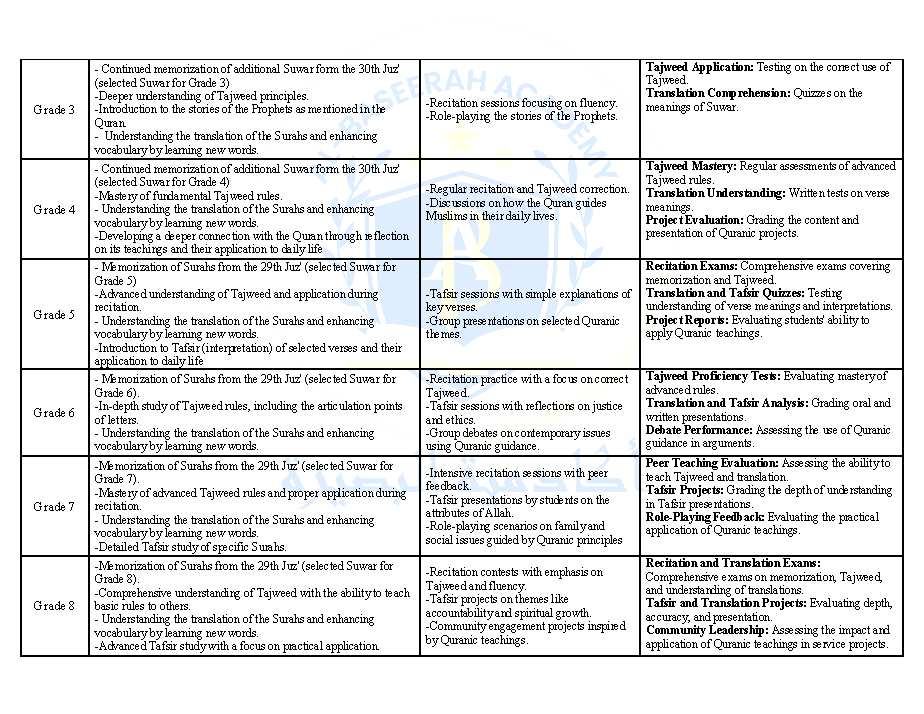
Curriculum outline
The same outline as published tables: