Arabic Curriculum: Pre-K to Grade 8
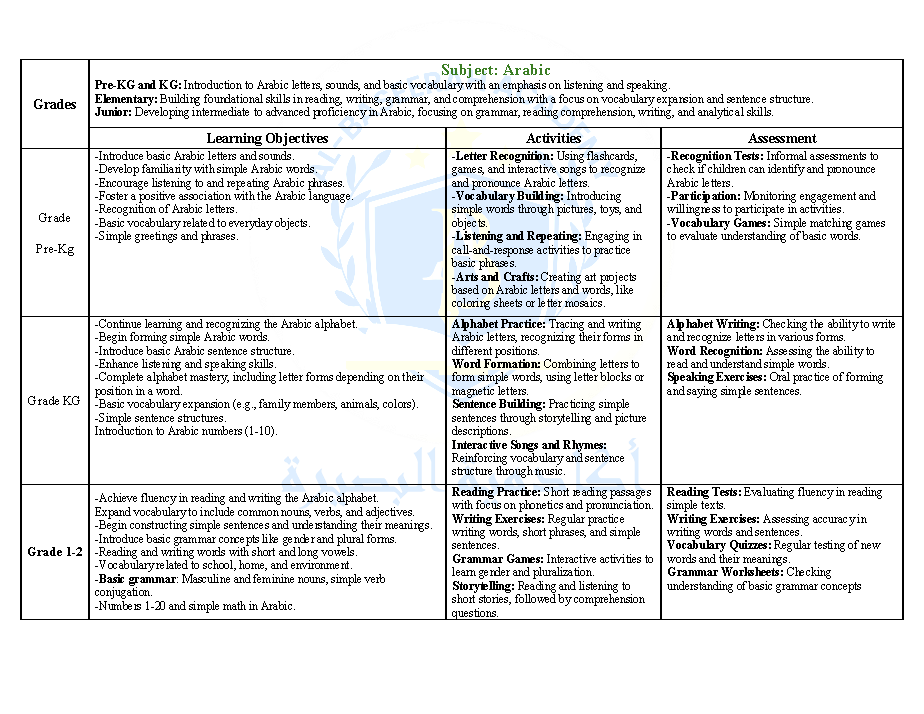
Arabic at Al Baseerah Academy is taught in three broad stages. Pre-K and Kindergarten introduce Arabic letters, sounds and basic vocabulary, with an emphasis on listening and speaking. Elementary builds foundational skills in reading, writing, grammar and comprehension, focusing on vocabulary expansion and sentence structure. Junior develops intermediate to advanced proficiency, focusing on grammar, reading comprehension, writing and analytical skills.
The grade-by-grade outline below sets out the learning objectives, classroom activities and assessment methods at each stage.
Pre-K
Learning objectives
- Introduce basic Arabic letters and sounds.
- Develop familiarity with simple Arabic words.
- Encourage listening to and repeating Arabic phrases.
- Foster a positive association with the Arabic language.
- Recognition of Arabic letters.
- Basic vocabulary related to everyday objects.
- Simple greetings and phrases.
Activities
- Letter recognition: flashcards, games and interactive songs to recognize and pronounce Arabic letters.
- Vocabulary building: introducing simple words through pictures, toys and objects.
- Listening and repeating: call-and-response activities to practice basic phrases.
- Arts and crafts: art projects based on Arabic letters and words, such as coloring sheets or letter mosaics.
Assessment
- Recognition tests: informal assessments to check if children can identify and pronounce Arabic letters.
- Participation: monitoring engagement and willingness to take part in activities.
- Vocabulary games: simple matching games to evaluate understanding of basic words.
Kindergarten
Learning objectives
- Continue learning and recognizing the Arabic alphabet.
- Begin forming simple Arabic words.
- Introduce basic Arabic sentence structure.
- Enhance listening and speaking skills.
- Complete alphabet mastery, including letter forms depending on their position in a word.
- Basic vocabulary expansion: family members, animals, colors.
- Simple sentence structures.
- Introduction to Arabic numbers 1 to 10.
Activities
- Alphabet practice: tracing and writing Arabic letters, recognizing their forms in different positions.
- Word formation: combining letters to form simple words, using letter blocks or magnetic letters.
- Sentence building: practicing simple sentences through storytelling and picture descriptions.
- Interactive songs and rhymes: reinforcing vocabulary and sentence structure through music.
Assessment
- Alphabet writing: checking the ability to write and recognize letters in various forms.
- Word recognition: assessing the ability to read and understand simple words.
- Speaking exercises: oral practice of forming and saying simple sentences.
Grades 1 and 2
Learning objectives
- Achieve fluency in reading and writing the Arabic alphabet.
- Expand vocabulary to include common nouns, verbs and adjectives.
- Begin constructing simple sentences and understanding their meanings.
- Introduce basic grammar concepts such as gender and plural forms.
- Reading and writing words with short and long vowels.
- Vocabulary related to school, home and environment.
- Basic grammar: masculine and feminine nouns, simple verb conjugation.
- Numbers 1 to 20 and simple math in Arabic.
Activities
- Reading practice: short passages focusing on phonetics and pronunciation.
- Writing exercises: regular practice writing words, short phrases and simple sentences.
- Grammar games: interactive activities to learn gender and pluralization.
- Storytelling: reading and listening to short stories, followed by comprehension questions.
Assessment
- Reading tests: evaluating fluency in reading simple texts.
- Writing exercises: assessing accuracy in writing words and sentences.
- Vocabulary quizzes: regular testing of new words and their meanings.
- Grammar worksheets: checking understanding of basic grammar concepts.
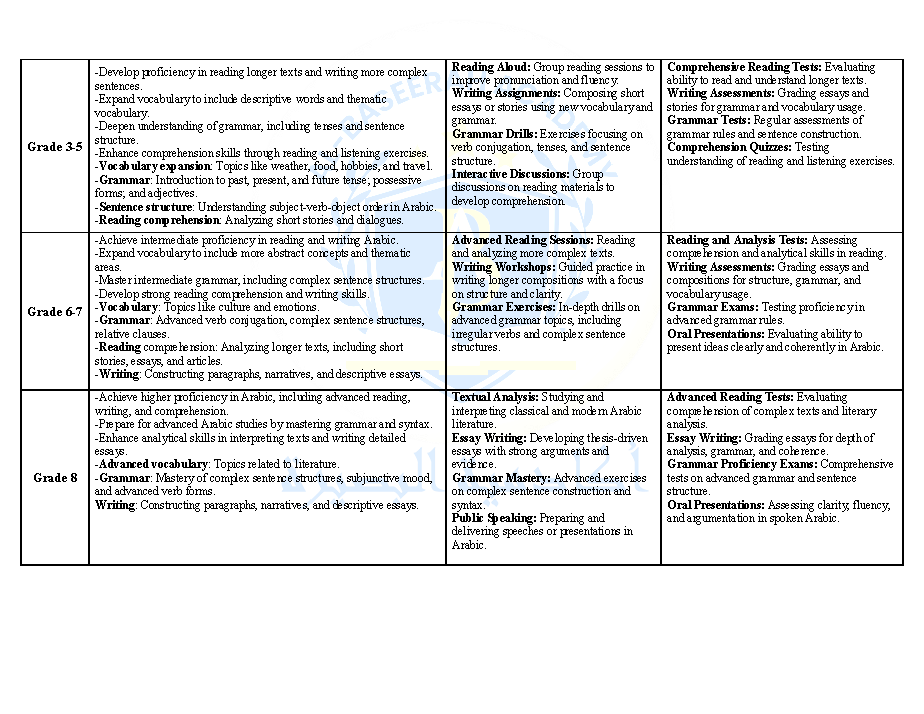
Grades 3 to 5
Learning objectives
- Develop proficiency in reading longer texts and writing more complex sentences.
- Expand vocabulary to include descriptive and thematic words.
- Deepen understanding of grammar, including tenses and sentence structure.
- Enhance comprehension skills through reading and listening exercises.
- Vocabulary expansion: weather, food, hobbies and travel.
- Grammar: past, present and future tense; possessive forms and adjectives.
- Sentence structure: subject-verb-object order in Arabic.
- Reading comprehension: analyzing short stories and dialogues.
Activities
- Reading aloud: group reading sessions to improve pronunciation and fluency.
- Writing assignments: composing short essays or stories using new vocabulary and grammar.
- Grammar drills: exercises focusing on verb conjugation, tenses and sentence structure.
- Interactive discussions: group discussion of reading materials to develop comprehension.
Assessment
- Comprehensive reading tests: evaluating ability to read and understand longer texts.
- Writing assessments: grading essays and stories for grammar and vocabulary usage.
- Grammar tests: regular assessments of grammar rules and sentence construction.
- Comprehension quizzes: testing understanding of reading and listening exercises.
Grades 6 and 7
Learning objectives
- Achieve intermediate proficiency in reading and writing Arabic.
- Expand vocabulary to include more abstract concepts and thematic areas.
- Master intermediate grammar, including complex sentence structures.
- Develop strong reading comprehension and writing skills.
- Vocabulary: culture and emotions.
- Grammar: advanced verb conjugation, complex sentence structures, relative clauses.
- Reading comprehension: analyzing longer texts including short stories, essays and articles.
- Writing: constructing paragraphs, narratives and descriptive essays.
Activities
- Advanced reading sessions: reading and analyzing more complex texts.
- Writing workshops: guided practice in longer compositions, focusing on structure and clarity.
- Grammar exercises: in-depth drills on advanced topics, including irregular verbs and complex sentence structures.
Assessment
- Reading and analysis tests: assessing comprehension and analytical skills in reading.
- Writing assessments: grading essays and compositions for structure, grammar and vocabulary usage.
- Grammar exams: testing proficiency in advanced grammar rules.
- Oral presentations: evaluating ability to present ideas clearly and coherently in Arabic.
Grade 8
Learning objectives
- Achieve higher proficiency in Arabic, including advanced reading, writing and comprehension.
- Prepare for advanced Arabic studies by mastering grammar and syntax.
- Enhance analytical skills in interpreting texts and writing detailed essays.
- Advanced vocabulary: topics related to literature.
- Grammar: mastery of complex sentence structures, subjunctive mood and advanced verb forms.
- Writing: constructing paragraphs, narratives and descriptive essays.
Activities
- Textual analysis: studying and interpreting classical and modern Arabic literature.
- Essay writing: developing thesis-driven essays with strong arguments and evidence.
- Grammar mastery: advanced exercises on complex sentence construction and syntax.
- Public speaking: preparing and delivering speeches or presentations in Arabic.
Assessment
- Advanced reading tests: evaluating comprehension of complex texts and literary analysis.
- Essay writing: grading essays for depth of analysis, grammar and coherence.
- Grammar proficiency exams: comprehensive tests on advanced grammar and sentence structure.
- Oral presentations: assessing clarity, fluency and argumentation in spoken Arabic.
Curriculum outline
The same outline as published tables: